
The Hybrid Operating Model: How Companies Regain Control and Performance in Asia Supply Chains
The Structural Problem Facing Asia-Based Supply Chains
With today’s operational backdrop of evolving tariffs, inflation, and demographic shifts, many executives are realizing their current supply chain designs are suboptimal and that their procurement organization slack agility.
Businesses today need a new approach to how they manage global supply chains, or they run the risk of being lapped by more agile competitors. In response, a hybrid operating model is emerging, one that separates strategic control from operational execution while restoring cost discipline and flexibility.
Just as companies rushed to open JVs and sourcing offices in the mid-2000’s capitalizing on China’s low labor costs, now, companies are looking to trade a single country focus for a regional approach and staffing models which can easily scale up or down based on operational needs in those geographies.
Companies are looking to trade a single country focus for a regional approach and staffing models which can easily scale up or down
To support this strategic shift increasingly, businesses are choosing to divest various non-core supply chain functions to reduce cost and risk, and at the same time, increasing focus on their own core competencies to accelerate growth and improve profitability.
Below we examine why traditional capital-intensive and country specific procurement teams are underperforming and how companies can approach evaluating if outsourcing some or all these supply chain functions makes strategic sense for their business.
Why Traditional Sourcing Offices Are Underperforming
For over twenty years, simply having a sourcing office or team on the ground in China provided a gateway to source highly competitive product with a comparatively cheap investment in staff and minimal managerial oversight required.
Over time, sales teams in the US have driven supply chain decisions resulting in companies having too many suppliers and unprofitable long tail SKUs. Directors of quality have pushed for more inspectors and quality engineers, and Procurement professionals have implemented few structural changes to drive increased supply chain performance.
Today, companies are now finding themselves saddled with legacy offices which pose declining strategic value in a world of remote work, large teams which do not match future operational needs, and ever rising costs from both suppliers and staff as China becomes less competitive compared to other emerging markets.
Many are coming to realize that their long-standing procurement teams are no longer the right people in the right place.
Companies are facing rising fixed costs tied to foreign procurement offices while order volumes are re-routed to new markets and staff sizes in China remain unchanged. The result is underutilized headcount and declining return on supply chain capital. What was once a variable advantage has become a fixed cost burden.
This capital-intensive model which relied on a large wage gap between the US and China is not adaptable for a new era which relies on a multi-market approach to sourcing, leaner operations capable of providing deep visibility, and organizational flexibility which can react to volatile headlines.
The fact is, to be successful in both China or even Asia more broadly, most companies do not need an office or large teams with complex workflows. Instead, companies need a sound supply chain strategy, and the right people in the right places.
However, many are coming to realize that their long-standing procurement teams are no longer the right people in the right place. The hybrid operating model addresses this misalignment by converting fixed foreign overhead into a scalable, performance-aligned cost structure.
Why a Hybrid Approach Drives Improved Performance
When executives examine their foreign procurement teams in Asia they often realize their foreign staff are structured primarily around transactional execution rather than strategic supply chain design. In turn, many recognize their foreign teams in Asia are critical to operations but distinctly separate from how their companies generate and extract value in the marketplace.
From R&D, to exceptional customer service, to sales and marketing, companies are often leading innovation domestically and simply relying on foreign teams to execute business strategies outlined by domestic personnel. This distinction opens the door for companies to capture immense value through outsourcing.
Whether it is outsourcing specific supply chain functionslike quality control management, sourcing, or auditing, companies see a widerange of benefits including:
-
Cost savings and improved cost control
-
Access to specialized expertise and operationalflexibility
-
Increased performance and reduced bottlenecksaround core competencies
-
Improved organizational alignment and lower risk
-
Scalable platform to support growth and expansion
Through outsourcing, companies can better focus on their core competencies, which are the source of their competitive advantage in the marketplace. This leads to faster growth and improved financial performance.
When using a hybrid approach with an explicit center-led supply chain management philosophy, companies can clearly map supply chain strategies, outsource execution to more cost-effective outside parties, while still retaining control with in-house supply chain professionals overseeing supply chain decision making and performance KPIs.
Outsourcing in these instances isn’t a matter of losing control or ownership, but instead deciding to focus on what matters most within a company’s workflows and processes.
How Companies Approach Outsourcing
Once a company has opted to explore outsourcing their supply chain operational responsibilities in Asia, they typically have four options. The first is function specific. In this scenario, companies identify a non-core responsibility such as quality control management or sourcing and opt to transition this specific function to an outside party. This is the most common approach and a good first step in building a leaner foreign team.
Beyond function specific outsourcing, companies can often approach a deep instead of wide strategy, focused on outsourcing all functions with a small subset of suppliers, typically those who have been historically problematic where upside potential associated with a change in management outweighs the downside risk.
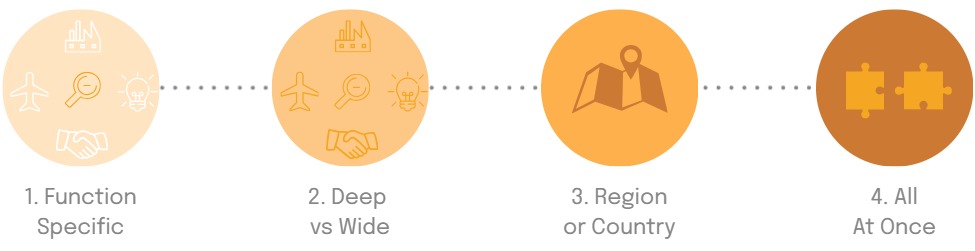
Outsourcing Stratgies
- Function Specific
- Deep vs Wide
- Region or Market Specific
- All-At-Once
This deep instead of wide principle can also be applied to specific geographies. Recently, many companies with long-standing teams in China have burgeoning supply bases in adjacent markets such as Vietnam, Thailand, Cambodia, and India which are being ineffectively managed by legacy procurement teams in China. In these cases, companies can also use a country or region specific approach, outsourcing supply chain responsibilities in new markets, then after trust and confidence is earned with an outside party, they begin addressing how to lean out legacy teams in China.
Lastly, for the bold or those already going through more comprehensive restructuring following financial difficulties or M&A, companies can pursue an all-at-once rollout. This approach works best for companies at either end of the growth and sophistication spectrum. On one end, small companies with few formal processes face generally low risk adopting an outsourced model which can provide more formality and structure, while at the other end of the spectrum, large sophisticated companies with proven business processes can easily integrate with a proven third party service provider.
So what makes this outsourcing model hybrid? It comes down to control. With a hybrid model regardless of rollout approach, domestic organizations remain the focal point for strategy, supply chain design, and have ultimate decision-making authority.
In a hybrid model, staffing and execution is outsourced to cost-efficient providers who are completely aligned with a business’s domestic priorities and ultimately controlled by domestic leadership as opposed to a foreign team operating as a separate business unit or unsupervised team in the field.
Who Is a Good Fit for Outsourcing
Good candidates for outsourcing take many shapes and sizes; but typically, the best fit are those who embrace a culture of continuous improvement, have a strong understanding of their business’s own core competencies, and have hands-on leadership.
Beyond these high-level criteria, companies with established business processes, historic performance data, and substantial daily supply chain activity are best suited to both seamlessly transition supply chain responsibilities to an outside party and reap substantial benefits, typically with 20-30% lower costs tied to overhead and overstaffing.
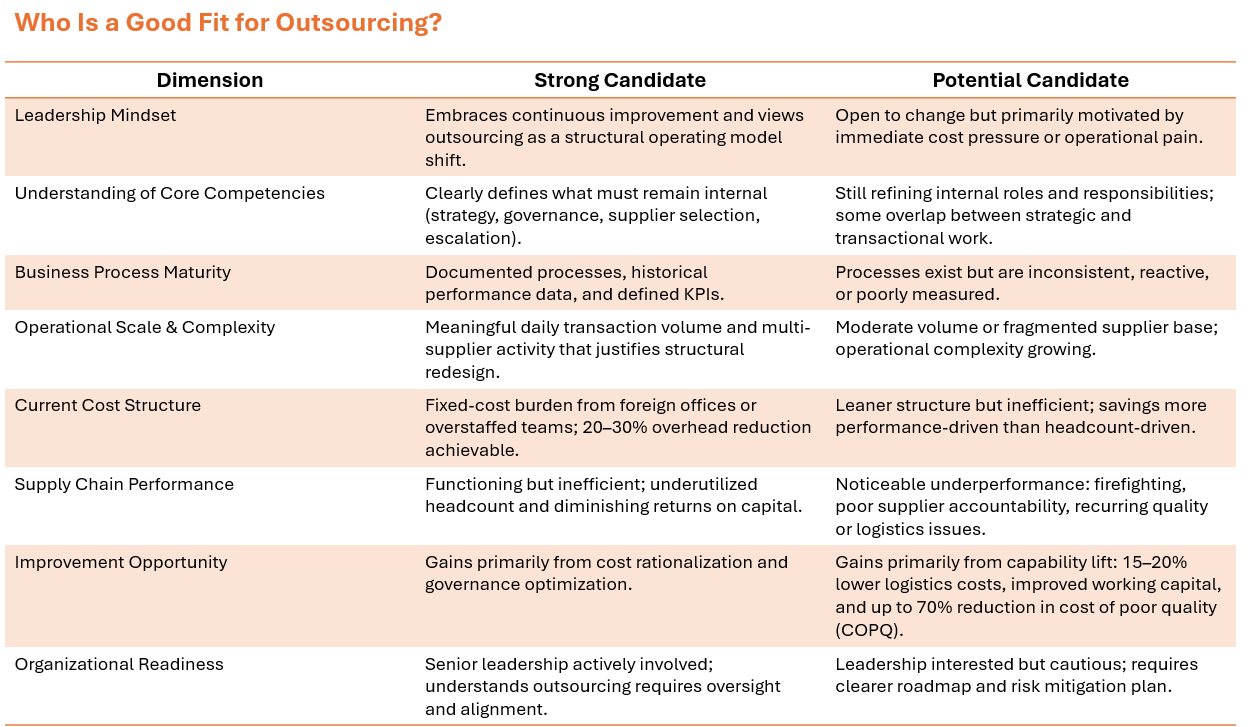
While these companies are the best candidates for outsourcing, companies who also see significant supply chain under performance also realize substantial cost and performance improvement through outsourcing.
Though typically smaller and mid-size companies, those who have been using trading companies, agents, or small foreign teams tend to see outsized savings around improved supply chain performance compared to overhead and staff savings alone.
Here companies are often presented with new capabilities and supply chain expertise which can be used to drive structural improvements, increase visibility, and better align supply chain strategy with reality on the ground. The new perspective and guidance from an outsourced service provider tend to result in 15-20% lower logistics costs, better use of working capital, and up to 70% reduction in cost of poor quality (COPQ).
While the sizes and background of companies vary greatly, those who are the best fit for outsourcing are those who understand that using a third party to manage their supply chain is a strategic shift and not solely a path to cost reduction or a panacea to supply chain underperformance. With a hybrid model, companies access cost-effective, flexible, and capable operators, but leadership and guidance is still required from domestic supply chain teams.
What a Transition Looks Like
Successful transitions to a hybrid model follow two disciplined phases: scoping and implementation. Initial scoping can take any wherefrom a couple months to nearly a year depending on complexity of an organization and their supply chain.
Scoping
In the scoping process, those looking to outsource supply chain functions can expect to conduct multiple discovery meetings with their outside service provider to document current supply chain design, historic performance metrics, key cost drivers, and importantly desired end-state goals. The more information and transparency during the discovery process, the higher probability for success.
Knowledge exchanges should not be viewed as negotiations but a cornerstone for long-term collaboration. Withholding vital information with an outside service provider is not advantageous for either party and usually results in misalignment, sowing the seeds for a potentially contentious relationship.
Knowledge exchanges should not be viewed as negotiations but a cornerstone for long-term collaboration.
Through this discovery process, companies should include multiple stakeholders and solicit feedback from even tangential functions which may not be outsourced directly but who may be impacted by the transition. In practice, some of the most valuable qualitative feedback comes from outsourcing detractors within an organization.
Addressing these concerns early separates adequate transitions from exceptional ones. From concerns around control, competency, or even failed efforts in the past, proactively documenting these concerns is a valuable exercise in risk management and building momentum, especially if you can identify “quick win” opportunities for these skeptics.
Ultimately, the decision to outsource is not strictly an operational decision, but a strategic and cultural decision.
Ultimately, the decision to outsource is not strictly an operational decision, but a strategic and cultural decision. Getting organizational buy-in, even with muted skepticism, is far better than merely mandating outsourcing from the C-Suite alone.
Implementation
After a program has been successfully scoped and potential risks identified, the implementation process can begin. Here too, implementation can be accomplished within a matter of months for most SMEs and again up to six months or longer for enterprise companies.
The key with implementation is to use a staged approach with clear performance toll gates and predetermined feedback points to address new challenges. Regardless of whether a company is using a function-specific, deep vs wide, geographic, or all-at-once rollout, continuity of operations must remain at the forefront of all transitions. A staged approach preserves control and creates insulation when disruptions occur — because they will.
A staged approach preserves control and creates insulation when disruptions occur — because they will.
As highlighted by Ernst & Young in How asset-light strategies and models can boost business growth, executives increasingly adopt asset-light models, yet concerns around control, visibility, and implementation risk persist. These concerns rarely stem from the concept itself — they arise from how transitions are scoped and governed.
Conclusion
From the moment a company explores a hybrid model, a competent service provider should present a structured framework for discovery, scoping, and implementation. Clarity in process reduces perceived risk and builds executive confidence before operational changes begin.
As global supply chains fragment and capital efficiency faces greater scrutiny, operating models are increasingly judged by their flexibility and resilience. A hybrid approach is not universally appropriate — but for organizations carrying legacy fixed-cost structures in dynamic markets, it warrants serious evaluation.
Resilience is engineered, not assumed. Hybrid operating models can restore flexibility without surrendering control, but outcomes depend on how deliberately the transition is scoped and governed. For organizations willing to assess their structure objectively, the greater risk may not be change — but remaining structurally exposed.