
Why Supply Chain Transformations in China Fail Before They Begin
Why the human element—not strategy—is the reason programs stall, and how leaders can secure real buy-in.
Executives are under relentless pressure to reduce supply chain costs, increase visibility, improve quality, and strengthen operational resilience. Yet even when supply chain improvement opportunities are obvious, initiatives in China and other low-cost regions often meet internal resistance:
The objections are predictable: “We tried that before—it didn’t work.” “Our suppliers won’t change.” “We don’t have the bandwidth right now.” Each reflects hesitation rooted in people, not strategy.
These objections are rarely about capability—they are about people, perceived risk, and disruption of routine. The result is predictable: stalled transformations, half-measures, and slow erosion back to the status quo.
Having corrected numerous failed initiatives across China and Southeast Asia, we have observed a consistent pattern: organizations focus heavily on strategy, technology, and savings targets, but underinvest in the human adoption required to make change stick.
Supply chain teams understand theoretical benefits like lower COPQ or improved OTIF—but what they feel day-to-day are long hours, more firefighting, and additional workload during implementation. Unless leaders frame improvement in human terms, transformation fatigue sets in long before benefits are realized.
The good news is that with small shifts in communication and incentives, leaders can unlock meaningful engagement, accelerate adoption, and generate momentum that carries programs forward instead of constantly pushing them uphill.
The Blind Leading the Blind
Transformations stall when teams cannot see the future you’re asking them to build.
Nearly every major supply chain transformation requires incremental work before value appears, new scorecards, supplier data gathering, audits, cross-functional meetings. Without a clear narrative explaining why change is necessary, who benefits, and how individuals’ lives will get easier, teams default to skepticism and avoidance.
Consider a Purchasing Manager who has managed the same suppliers in China for 20 years and outlasted eight VP’s of Supply Chain. When instructed to roll out supplier scorecards or rationalize suppliers, what is her first thought?
Is it improved supply chain visibility and economies of scale? Or is it: Where will I find the time for this on top of everything else?
Executives often communicate in business outcomes: cost reductions, inventory turns, risk mitigation. Teams operate in lived realities: late-night calls, inspections going sideways, suppliers missing deadlines. Both are valid, but only one is felt in the moment.
To bridge that gap, leaders must connect improvement metrics to what matters to people on the ground:
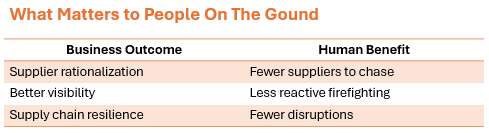
When people believe the future state reduces pain instead of creating more of it, engagement changes overnight. A vision statement alone is not sufficient—it must be personalized.
Does Success Really Have Many Fathers?
Organizations often miss early green shoots because they are looking only for the finish line.
Behavioral research confirms that people remember negative events far more vividly than positive ones. In supply chain transformations, this bias works against progress, teams recall the failure of the last initiative, not the value of the current one.
Change agents often face a thankless cycle: persuade skeptics, launch initiatives, push through setbacks, repeat. Without visible recognition, even committed employees burn out.
Small milestones matter and serve as proof that change is working. When suppliers submit data on time, processes are followed correctly, quality problems occur less frequently, and teams start collaborating across departments rather than escalating, you know that momentum is building.
Individually these may seem minor. In reality, they are early proof that the transformation is working and early wins are the currency of momentum. Research shows organizations that regularly recognize progress report 21% higher profitability and 31% lower voluntary turnover, according to executive coach Richard Reid.
Small milestones matter and serve as proof that change is working.
Celebration does not require ceremony; it requires intention. Leaders can call out progress in weekly meetings, share stories of how teams navigated obstacles, and recognize individuals publicly when their behaviors align with the desired future state. Each of these small acts reinforces momentum and signals that effort is noticed and valued.
What gets recognized gets repeated.
Closing Thought
Transformation is not a single event; it is a journey that requires alignment, belief, and consistency long before results hit a dashboard. When leaders clearly articulate the why, connect outcomes to human benefit, and recognize progress along the way, execution follows with far less friction. Teams lean in rather than lean away. Resistance gives way to ownership. Progress starts to compound.
For organizations facing stalled initiatives, or those preparing to embark on supply chain performance improvement across China or Southeast Asia, The ABC Group helps mid-market and enterprise manufacturers improve results without adding headcount or capex.
We focus on both the technical and the human sides of transformation because in our experience, one without the other rarely succeeds.