
China Is No Longer Cheap—But It Can Be Cost-Effective
Why rising supply chain costs in China demand leaner, process-driven supply chain management—not more headcount
With rising tariffs, persistent inflationary pressure, and increased geopolitical friction, nearly every manufacturer is working hard to reduce supply chain costs. Many organizations have responded in familiar ways—negotiating price concessions with suppliers, optimizing logistics routes, or tightening short-term spending controls to protect margins.
These supply chain cost reduction strategies may provide temporary relief, but for many companies they no longer address the core issue. At the executive level, a growing realization has taken hold: China is no longer a “cheap” place to operate. That shift is fundamentally changing how leaders think about where to manufacture, how to structure sourcing organizations, and what it truly takes to remain cost-competitive in the region.
The more nuanced reality is this: while China is no longer cheap, it can still be cost-effective. Achieving that outcome, however, requires a different management model—one that reflects China’s structural evolution rather than relying on assumptions formed during the era of extreme labor arbitrage.
This article outlines the most significant macro and micro cost drivers reshaping supply chain economics in China today and explains why companies that adapt their operating model—not just their sourcing strategy—are best positioned to control costs going forward.
The good news is that with small shifts in communication and incentives, leaders can unlock meaningful engagement, accelerate adoption, and generate momentum that carries programs forward instead of constantly pushing them uphill.
A Country Transformed: Rising Standards of Living
Since China’s admission to the WTO in 2001, the country has undergone one of the fastest and most consequential economic transformations in modern history. In just over two decades, China evolved from a largely agrarian economy into the factory of the world—and is now actively competing in advanced and frontier technologies.
This transformation has been accompanied by a deliberate national focus on improving standards of living. GDP per capita has increased more than fourteen-fold since large-scale foreign sourcing began in the early 1990s. Life expectancy has risen by nearly a decade. Educational outcomes have improved dramatically, with Chinese students ranking among the highest globally on standardized assessments.
These changes are structural, not cyclical. A better-educated workforce with rising expectations around compensation, work-life balance, and quality of life is not a temporary phenomenon—and it will persist long after trade policy shifts or currency cycles play out.
For companies operating in China, this means that many of the most significant cost drivers within their supply chains and procurement organizations are no longer reversible. The question is no longer how to return to the past, but how to operate effectively in the present.
Where Rising Costs Show Up at the Macro Level
As China has transitioned from a developing to a developed economy, several macro-level forces have emerged that disproportionately impact foreign supply chains.
Knowledge Worker Wage Growth
Over the past decade, white-collar wages in China have grown at roughly 8% annually, significantly outpacing wage growth in the United States. When combined with expanding benefits and regulatory requirements, total compensation for procurement, quality, and supply chain professionals has increased dramatically—by as much as 70–75% since the mid-2010s.
Logistics Costs
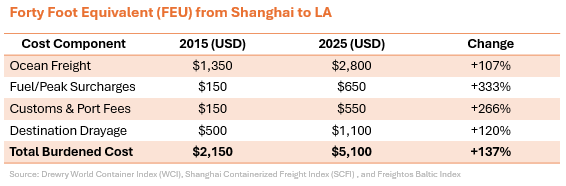
Logistics costs from China have also risen sharply. Even excluding tariffs, door-to-door ocean freight costs from major Chinese ports to the U.S. West Coast remain materially higher than pre-pandemic levels. While logistics remains a cyclical industry, the long-term trend reflects higher fuel costs, port congestion, surcharges, and compliance burdens that are unlikely to fully unwind.
Regulatory Pressure
Foreign companies operating in Mainland China now face more consistent and enforceable regulation across taxation, environmental compliance, data security, and ESG reporting. Digitization initiatives and policy enforcement have increased both direct and indirect costs, with regulatory compliance contributing meaningfully to higher total landed costs. By some estimates, total landed costs of goods have increased 30-40% simply due to increased regulations.
Taken together, these forces make it clear that China’s cost structure has permanently shifted. But macro conditions alone do not determine competitiveness.
Staff Bloat
Despite declining U.S. imports from China since their 2016 peak, staffing levels within China-based sourcing and procurement organizations have remained largely unchanged. Years of “throwing people at problems” during the era of cheap labor—combined with sustained wage inflation—have left many companies with procurement cost structures that are materially higher than necessary.
Organizations operating in China are often carrying 30–50% more procurement and supply chain staffing cost than required
Based on our firm’s work with dozens of mid-market and enterprise manufacturers, organizations operating in China are often carrying 30–50% more procurement and supply chain staffing cost than required to support current volumes and complexity. In one representative supply chain cost reduction case study, meaningful cost savings were achieved not by supplier price concessions, but by redesigning roles, consolidating responsibilities, and replacing ad hoc staffing with standardized, repeatable management processes.
Poor Supplier Accountability
For decades, late deliveries, recurring quality issues, and limited visibility were tolerated because manufacturing costs were low. That tolerance has persisted even as China’s cost advantage narrowed. Many companies still fail to enforce contractual terms or address root-cause performance issues, allowing supplier underperformance to quietly erode margins year after year.
Inefficient, Human-Centered Management Processes
Perhaps the most overlooked cost driver is the reliance on people rather than processes. When labor was cheap, it made sense to hire inspectors or supplier-specific managers to solve problems as they arose. In today’s environment, that approach is both expensive and unscalable.
Modern supply chain organizations must shift toward durable, repeatable processes that reduce manual intervention, improve data accuracy, and minimize low-value work—both in China and at home. The hidden costs of inconsistent processes and unreliable information often exceed visible line-item expenses, while simultaneously preventing leaders from executing broader strategic initiatives.
Closing Thought
Tariffs may fluctuate and currencies may strengthen or weaken, but the reality remains: China is no longer a cheap market in absolute terms. Yet global supply chains are not built on absolutes—they are built on comparative advantage. China remains more cost-effective than many alternatives when managed correctly.
Companies that continue to operate with legacy, labor-heavy management models will struggle to control costs. Those that redesign how they manage suppliers, people, and processes can still harness meaningful cost advantages particularly in knowledge-intensive supply chain functions.
For organizations with sourcing and manufacturing operations in China or Southeast Asia, the path forward is not simply renegotiation or relocation. It requires a leaner, more disciplined operating model that prioritizes efficiency, accountability, and scalability.
The ABC Group partners with mid-market and enterprise manufacturers to help modernize supply chain management in China and Southeast Asia—improving cost effectiveness, visibility, and performance without adding headcount or capex.
If cutting COGS alone is no longer enough, it may be time to rethink how your supply chain is managed—not just where it operates.