Improvement initiatives rarely fail during the crafting of a supply chain transformation strategy. They fail because organizations do not execute consistently enough, long enough, and with the right success markers to see those strategies play out.
Based on our analysis of dozens of improvement initiatives across mid-market and enterprise companies with operations in China, we have highlighted a variety of pitfalls — from lack of vision and human buy-in to infrequent feedback loops — that frequently derail the supply chain transformation process. Here, we examine the risks associated with selecting the wrong KPIs, and how executives need to look beneath the surface to truly measure a transformation's impact.
Moving Beyond Dashboard Decorations: Selecting Outcome-Driven KPIs
Imagine you're preparing for a cross-country trip to a destination you have never visited before. You plot your route, fill your car with gas, and identify the places you will stop.
You wouldn't embark on that journey if your speedometer, GPS, and fuel gauge weren't working properly. Yet many organizations doom their transformation efforts before they even start by selecting KPIs that don't accurately reflect changing business conditions. Or worse, by combining faulty KPIs with unrealistic expectations disconnected from operational reality.
When companies use improper KPIs — or stretch goals that feel more like Hail Mary passes — executives are setting their organizations up for failure and disappointment. In any learning process (and most transformations are learning processes, both individually and organizationally) there is an optimal failure rate.
If a goal is too easy, it fails to retain engagement. Too challenging, you risk disenfranchisement. In both scenarios, success is at risk.
A case in point
An example of selecting the wrong metric: our firm was asked to audit dozens of suppliers as part of a private-equity-backed supply chain transformation in China. The project's stated goal on the surface was to evaluate supplier quality capabilities using client-specific audit criteria, improve supplier scores above a minimum threshold, and use supplier scorecards to monitor quality performance.
However, after analyzing historical quality data, we found zero correlation between a supplier's audit score and historical quality performance. Instead, the greatest correlation with quality performance was actually with a supplier's perceived strategic value within our client's supply chain.
It came down to whether a supplier wanted to consistently provide high-quality performance — more so than their ability to meet those performance benchmarks.
Once this dynamic became clear, we shifted to understanding the Voice of Supplier, which then exposed communication and alignment gaps between our client and their manufacturers. Only then, in closing those gaps, were we able to drive a nearly 50% reduction in quality defects — largely independent from any supplier's audit score.
The point is that executives need to look beneath the surface to drive real change. Had we focused only on improving supplier audit scores, our client most likely would not have seen improved quality performance — because audit scores were not, in this case, a valid metric for gauging quality at all.
What this means in practice
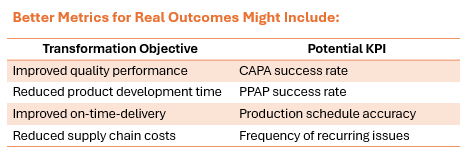
True improvement initiatives aren't window-dressing. They need to fundamentally address the core business issues at hand. If the goal is improved quality performance, tracking CAPA completion time may be more impactful than quality management system audit scores. Using prototype success rates may matter more than time-to-market for new product development.
Executives need to get into the weeds to identify the real markers of success. Even after metrics are selected, leaders should run a quick sensitivity analysis to confirm that a meaningful change in the metric translates into improved business performance — and not false signals.
Not all KPIs reflect improvement. Some simply measure activity.
If the KPI doesn't change business results, it's not a KPI — it's a dashboard decoration.
The Closing Thought
Selecting the right KPIs is not an academic exercise. It is a leadership decision that directly shapes behavior, momentum, and outcomes. In complex supply chain environments like China — where performance drivers are often opaque and misaligned — surface-level metrics can quietly undermine even well-intentioned transformation efforts.
The ABC Group partners with mid-market and enterprise manufacturers to identify outcome-driven metrics, align execution with operational reality, and drive measurable supply chain performance improvements in China and Southeast Asia — without adding headcount or capex.
If your transformation has the right strategy but the wrong scoreboard, it may be time to rethink what you're measuring — not who is doing the measuring.